Who's in there? Finding your voice in academic writing
Maybe you've done this: you ask ChatGPT or Claude or Gemini to draft something, then spend twenty minutes tweaking the language so it "sounds like you." You want to ensure your writing evokes an impression of you as a unique human writer That impulse points to a concept writing scholars have studied for decades. It's called voice.
While some scholars have used “voice” and “identity” interchangeably, Mhili (2023) maintains that voice isn't the same as identity. To clarify, she suggests that identity includes everything you bring to the world, while voice is narrower: it's what the text itself creates. Still, as I see it, your choices as a writer (what you foreground, what you hedge, what you let breathe) are shaped by who you are. So voice and identity are connected, even if you don’t think of them as the same thing.
We’re going to spend some time exploring voice here to tackle a common problem in academic writing: when the author’s voice goes missing.

“The most common observation that I make about graduate writing, by a large margin, is that it appears writer-less.”
—Cayley (2023)
How thinking about voice has evolved
Mhili (2023) tracked conceptualizations of writerly voice in the scholarly literature over time. The way scholars understand voice in writing has evolved from something purely individual to something socially constructed to something dialogic:
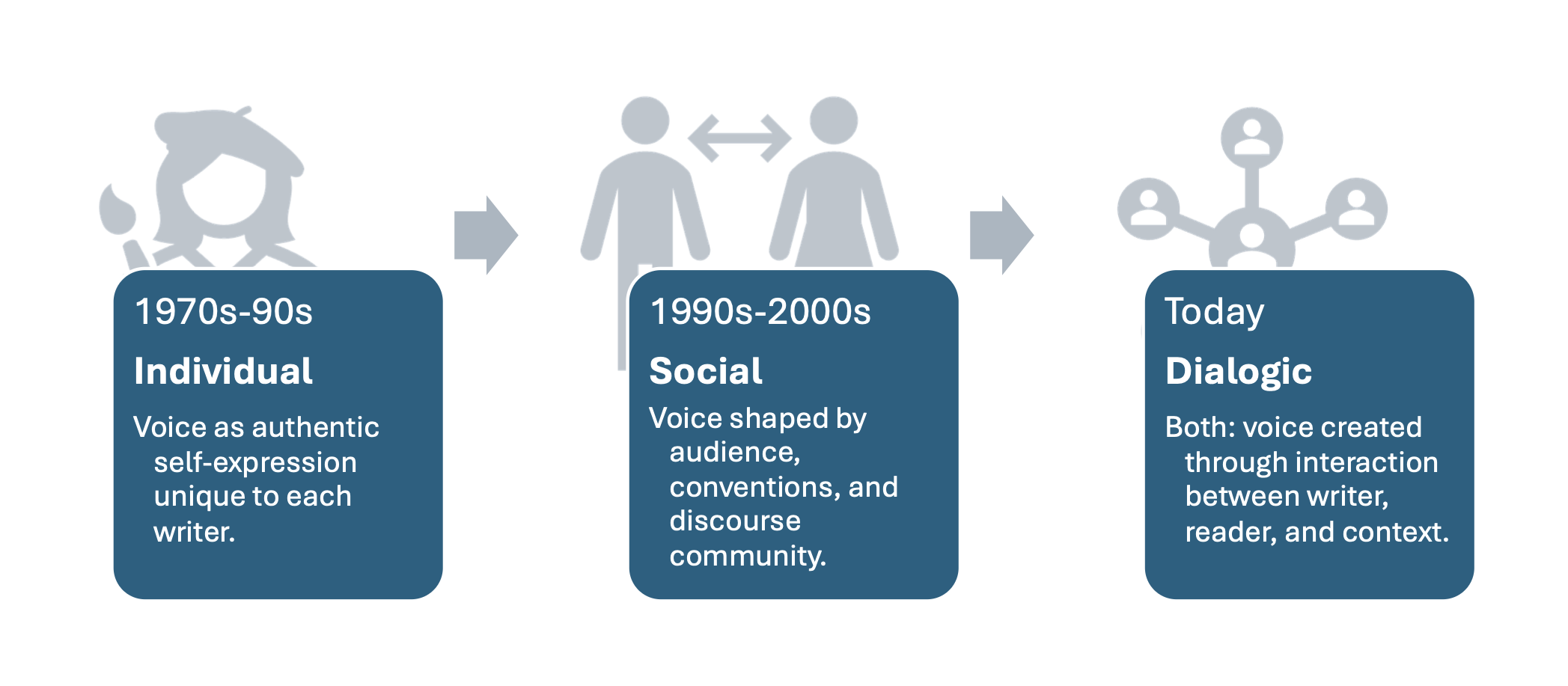
graphic showing the individual, social, and dialogic concepts of voice in writing
The dialogic view is useful for academic writers. You're not just expressing yourself, and you're not just playing by the field's rules. You're in a conversation—with your sources, your committee, your eventual readers—and your voice is what makes that conversation worth having.
Why this might matter to you
Voice matters when any of these are true: your research feels personally meaningful and you want your writing to convey that meaning; you're trying to signal to readers (a committee, a journal editor) that you belong in this discourse community; you want readers to trust you enough to stay with you through a long argument; or someone has told you that your writing lacks voice.

Reframe the feedback
"I can't hear your voice" is vague and easy to spiral about. Try this translation instead: I can't see your contribution. That's something you can actually fix. Add language to highlight what is novel and meaningful about your work compared to that of others. (Cayley, 2023)
What gets in the way
Cayley (2023) describes three obstacles—dampers, if you will—that mute voice in academic writing. The first is modesty: you downplay your contribution because it feels presumptuous to assert it. Second is what Cayley calls preoccupation with your material: you're so immersed in what you're saying that you forget to make the connections explicit for readers who aren't. And finally, for graduate student writers, is inexperience with disciplinary patterns: you haven't yet absorbed the conventions your field uses to signal authority and contribution.
When a writer-less draft reaches a reader, Cayley (2023) puts it plainly: the reader must do too much work. That work can tip into guesswork. Puzzled readers don't stay.
Four things you can try this week
Talk it before you type it. Use speech-to-text for a first pass on a tricky section. What comes out verbally is often clearer, less hedged, and more "you" than what you'd write cold. Particularly useful if you think better out loud, or if writing anxiety tends to flatten your voice.
Translate, don't just quote. When you cite a source, add a sentence in your own words: In other words, ___. This signals to readers (and yourself) that you've actually digested the idea, not just borrowed the authority (Graff & Birkenstein, 2024).
Dress it down, then dress it up. Take a paragraph from your current draft and rewrite it in casual, colloquial language. Then rewrite it again, in a more formal style. Then blend the two. You'll quickly see where the voice lives — and where it's been ironed out (Graff & Birkenstein, 2024).
Be a host, not a ghost. Cayley (2023) argues that academic writers must provide structural signposts, tell readers what's new, signal the value of your contribution, and create explicit local links between ideas. Hosting your reader through the text is not hand-holding; it's craft. Use templates from the Academic Phrasebank to make moves like “outlining the structure of the paper or dissertation,” “explaining the significance of the current study” and “signaling transition.”
References
Cayley, R. (2023). Thriving as a graduate writer: Principles, strategies, and habits for effective academic writing. University of Michigan Press.
Graff, G., & Birkenstein, C. (2024). “They say / I say”: The moves that matter in academic writing (Sixth edition). W.W. Norton & Company.
Mhilli, O. (2023). Authorial voice in writing: A literature review. Social Sciences & Humanities Open, 8, 1-11.